

App Design
ABOUT THE PROJECT
Adventures of Kasia was designed to delight our user, Kasia, by crafting an experience uniquely tailored to her preferences. The project focused on creating a distance fighting game, offering her a fun and engaging way to enjoy gaming on her terms.
Through collaboration, open communication, and creative brainstorming, we designed a game that provides Kasia with three distinct character options, each representing her personality and interests. This project aimed to deliver an enjoyable gaming experience while addressing her needs and ensuring she felt seen and valued as a user.
This project allowed us to explore elements of user-centric design, teamwork, and creativity, resulting in an experience that combines fun with functionality.


MY PROCESS
As the lead designer for Adventures of Kasia, I focused on creating a personalized experience that resonated with our users. To achieve this, I started by using Freeform to develop character concepts inspired by Kasia’s physical features, ensuring that each design reflected her individuality. This approach helped connect the user and the game, making the characters feel relatable and unique.
For the game’s background, I utilized Procreate to design an immersive environment that complemented the overall aesthetic and enhanced the gameplay experience. Every element was thoughtfully crafted to delight the user, balancing creativity with functionality.
By combining user-centered design principles with creative tools, I was able to bring Kasia’s world to life, ensuring an engaging and personalized gaming experience.


HI- Fi
Final Game

ABOUT THE PROJECT
Code Pac was an exciting challenge focused on creating a command-line game with no graphical user interface. As part of this project, we designed a minimalist yet engaging gameplay experience that mimics the classic Pac-Man style. Instead of a visual maze, the game operates on a grid system, with symbols representing key elements: pellets (*), Pac-Man (9), and the ghost (7).
The objective was to create a functional, fun game experience entirely through code while pushing the boundaries of creativity within the constraints of a text-based format. This project emphasized problem-solving, logic development, and collaboration to achieve a fully interactive game in the command line environment.
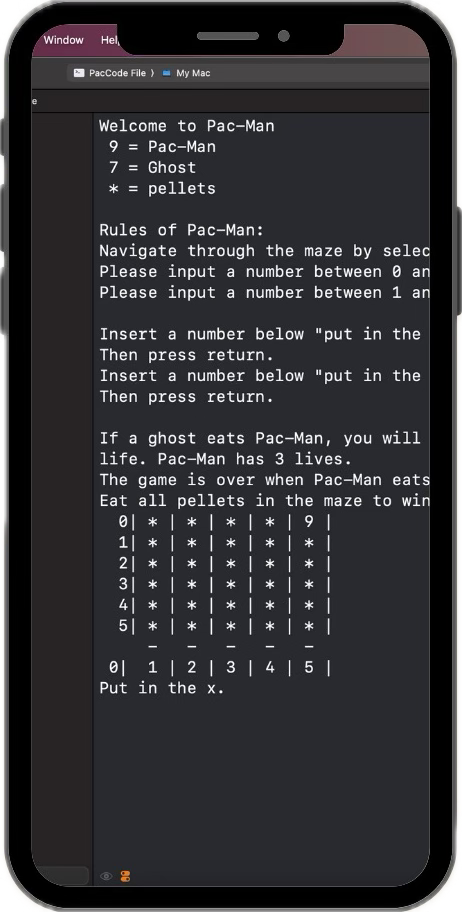
Final Game


MY PROCESS
Creating Code Pac was an opportunity to explore creativity within the limitations of a command-line game. Our team began by brainstorming ways to make the visuals engaging and fun, even without a traditional UI. We used arrays to define the game’s grid-based structure, carefully placing elements to create a sense of movement and strategy.
To add personality and humor, we incorporated the playful “7 ate 9” concept—turning the ghost (7) into a character that humorously ties into the game’s mechanics and narrative. This added an extra layer of enjoyment for players, blending logic with creativity.
By focusing on innovative ways to deliver a fun experience within the command-line environment, we brought Code Pacto to life as a quirky, text-based take on the classic Pac-Man concept.
ABOUT THE PROJECT
Cobra Ball was designed as a fast-paced, interactive game that challenges players to stay engaged and think on their feet. The game revolves around quick reflexes and strategic timing, where players control a cobra navigating through obstacles or challenges to achieve specific goals.
The project aimed to deliver a simple yet captivating experience, with a focus on fluid gameplay mechanics and intuitive controls. Using minimalistic elements, Cobra Ball combines strategy and fun, creating a game that’s easy to pick up but hard to master.
This project highlighted the importance of balancing simplicity with excitement, making it a rewarding experience for players and developers alike.


MY PROCESS
As the lead coder for Cobra Ball, this project was both a challenge and a valuable learning experience. Coding, in general, has been a growth area for me, and tackling this game pushed me to expand my skills, especially with SpriteKit.
I started by referencing code from previous projects, which gave me a foundation to build on. I also relied heavily on SpriteKit tutorials to better understand the framework’s capabilities and how to implement features like movement, collision detection, and animations. Along the way, I sought guidance from mentors who helped me troubleshoot issues and refine my code.
Despite the challenges, this process taught me the importance of persistence, leveraging resources, and seeking help when needed. The result was a functioning, engaging game that reflects the effort and collaboration it took to bring it to life.
Final Game
